

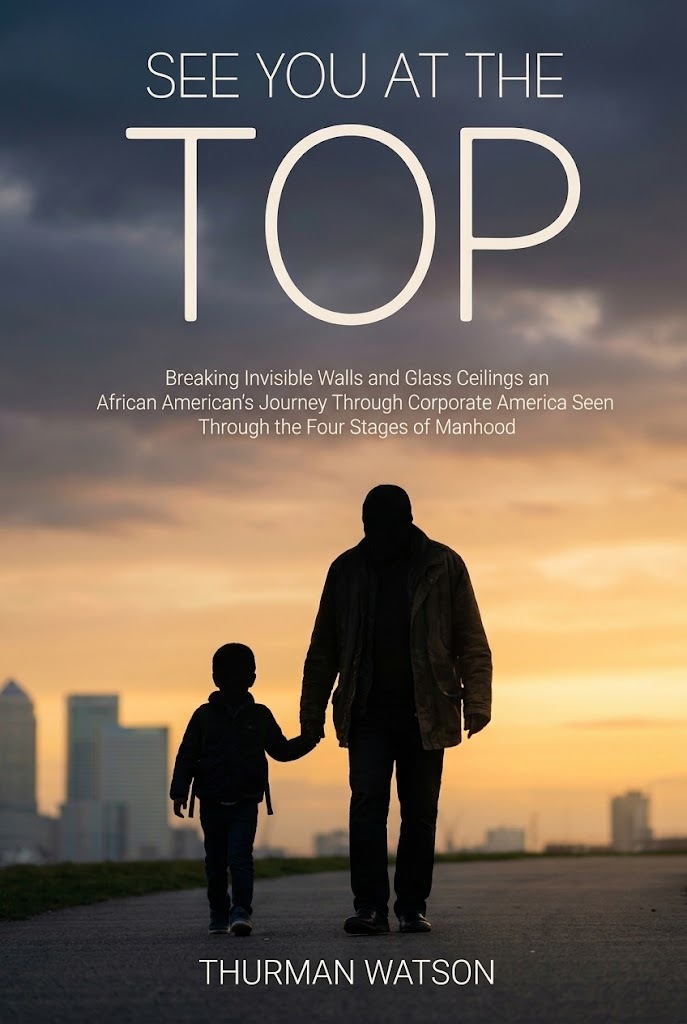
Breaking Invisible Walls and Glass Ceilings An African American’s Journey Through Corporate America Seen Through the Four Stages of Manhood
In 1969, A young Black man stepped into Corporate America with nothing but ambition, discipline and the hope of a community that believed he could rise higher than the world expected. What followed was a forty-year journey through invisible walls, glass ceilings, and the unspoken rules of a system not built for him, yet shone by his discipline, courage and purpose.
See You at the Top chronicles the life of Thurman, whose story unfolds through the four stages of manhood: Boyhood, Knighthood. Kingdom and Elderhood. From navigating racial barriers in corporate spaces, to founding a cardiovascular center that saved lives across Washington, D.C., to mentoring young athletes who became champions, this memoir reveals the quite strength behind a life of service.
But this is more than one man’s climb. It is a generational story.
It begins with a grandson crossing a graduation stage, and ends with the wisdom of an Elder who has lived long enough to see the next climber rise. Through triumphs, losses, and unbreakable will to serve his community, Thurman offers a blueprint for anyone determined to rise in spaces where they may be the only one.
See You at The Top tells that story — and invites readers to reflect on their own.

Early life, discipline and ambition shape's identity
Forging in the struggle of building a foundation corporate ascent and leadership
Serving what's been built. Coaching, mentorship and community impact
Recognizing one's purpose and perspective, showing others the path.

I still remember the sound of my shoes on the polished floor the first morning I walked into corporate America. It wasn’t fear I felt — it was awareness. Awareness of the silence when I entered the conference room. Awareness of the glances that lasted a second too long. Awareness that I was the only Black man in the building who wasn’t pushing a mail cart.
To understand the weight of the moment, you have to understand the world I was stepping into.
In 1970, the public accounting profession was overwhelmingly white, and intentionally exclusionary. Out of roughly 100,000 public accountants in the United States, only 150 were African American. The Big 8 CPA firms, the giants of the profession, controlled nearly every major corporate audit from 1960s through the 1980s. They were powerful, prestigious and deeply segregated.
But I also felt something else: determination.
I didn’t have a roadmap. I didn’t have a mentor waiting to guide me. What I had was preparation — hours of study, discipline, and a belief that excellence could open doors even when no one was holding them open.
That first week taught me a truth I carried for the rest of my career: You don’t have to know the whole path to take the first step

When they handed me the title “Manager,” it felt heavier than the paper it was printed on. I knew what it meant — not just responsibility, but visibility. Leadership in a space where few expected me to rise.
My first team watched me closely. Some were curious. Some skeptical. A few quietly resistant. Leadership isn’t granted by a title; it’s earned through consistency.
So I prepared harder than anyone else. I listened more than I spoke. I made decisions based on principle, not popularity.
I showed up every day like the job already belonged to me — and eventually, it did

The gym wasn’t fancy. The paint peeled. The lights buzzed. The floor had dead spots that swallowed the ball whole. But to the kids who walked through those doors, it was a sanctuary.
Coaching wasn’t about basketball — not really. It was about showing young people what discipline looked like, what preparation felt like, and what belief could do.
Over the years, I watched shy girls become leaders, quiet boys find confidence, and entire families rally around the idea that their children could be more than their circumstances.
Lifting up a community doesn’t always start with a grand plan. Sometimes it starts with a whistle, a gym, and a belief in what young people can become.

Copyright © 2026 Thurman The Writer. All rights reserved | Designed by Website Builders Official.